History
Aquila is one of the 48 constellations recognized by the ancient Greek astronomer Claudius Ptolemy, who is famous for ‘perfecting’ the geocentric solar system model. In Greek mythology, Aquila is an eagle, but exactly what kind of eagle is up for debate. Either way, the story centers around Zeus, yet again. In the legend Zeus was smitten with Ganymede, a son of the king of Troy, who the Iliad describes as the most beautiful of all mortals. In the story, Zeus then sends a giant eagle to kidnap Ganymede and bring him to Olympus to serve as a cup-bearer for the gods or transforms himself into the bird in order to accomplish the deed himself.
Visual/Where to Find
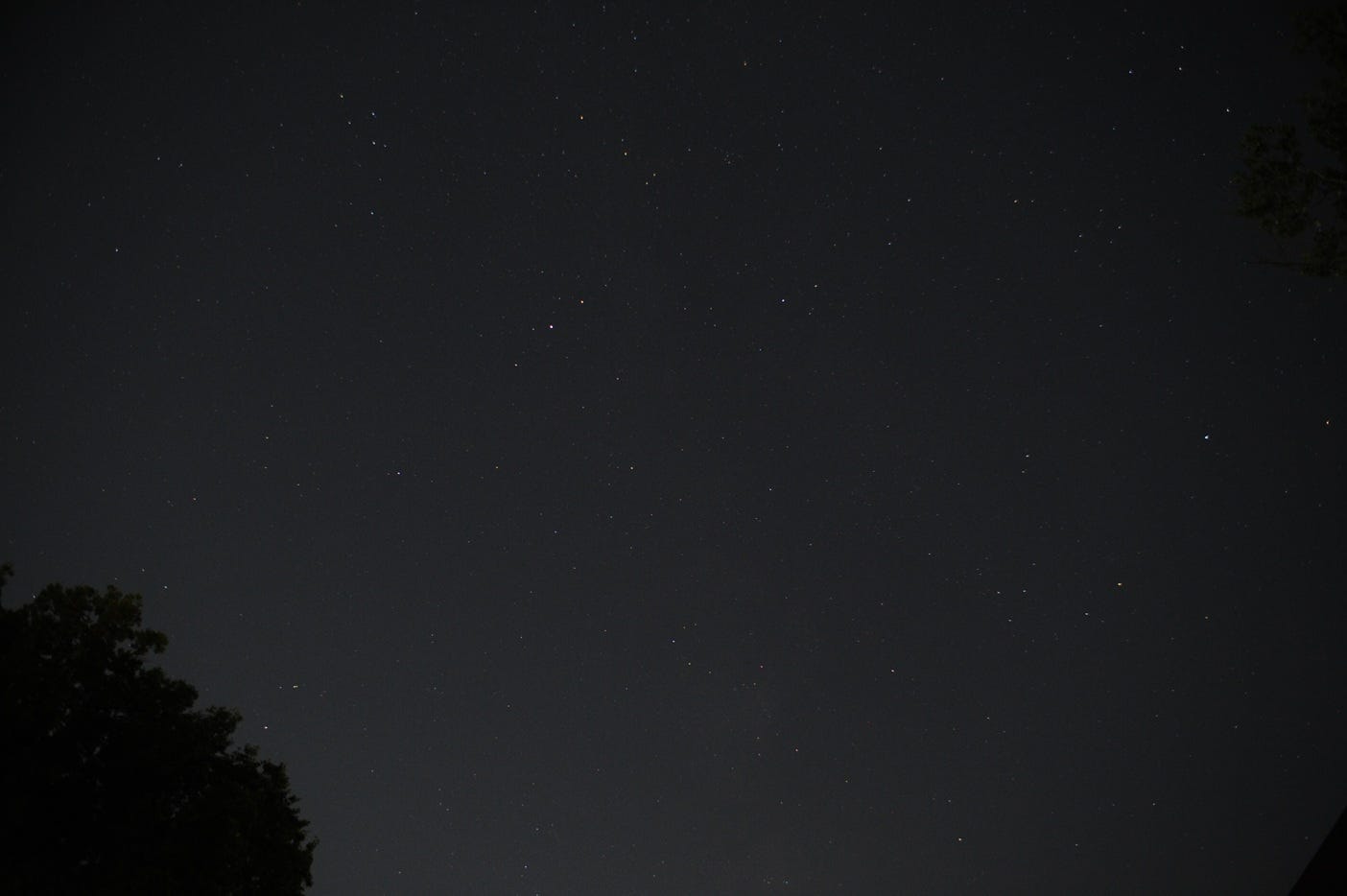
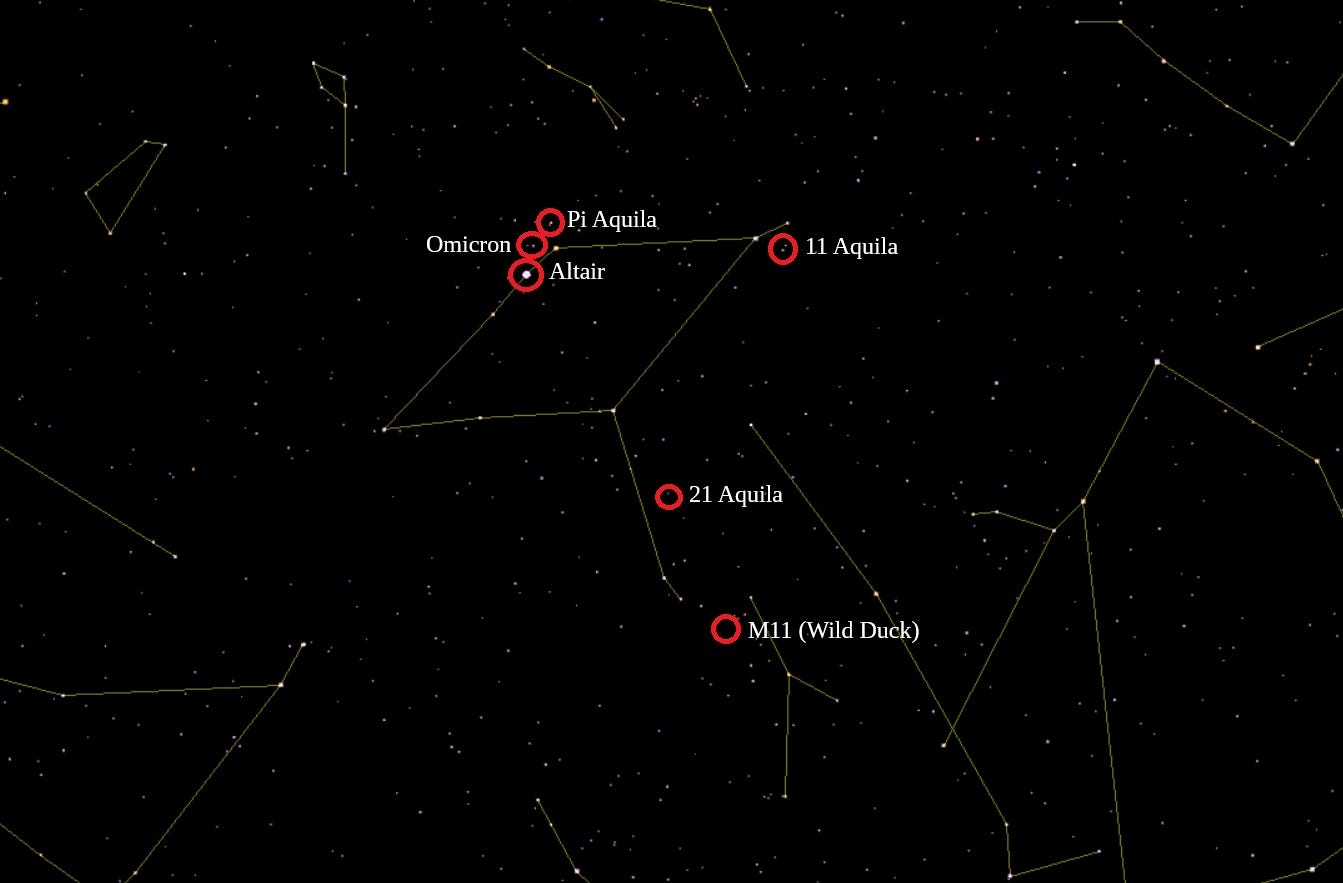
Aquila is easy to find high in the summer sky as its alpha star, Altair, forms the most Southerly vertex of the Summer Triangle asterism. Looking lower in the sky toward Sagitarrius, a vaguely bird-like shape (actually more like a pterodactyl) appears. The eagle’s body actually straddles the heart of the Milky Way itself, making the constellation especially photogenic for those who enjoy dark, rural skies. For the rest of us stuck in built-up areas, the high arc that Aquila takes through the sky helps to insulate it against light domes nearer the horizon.
In the Telescope
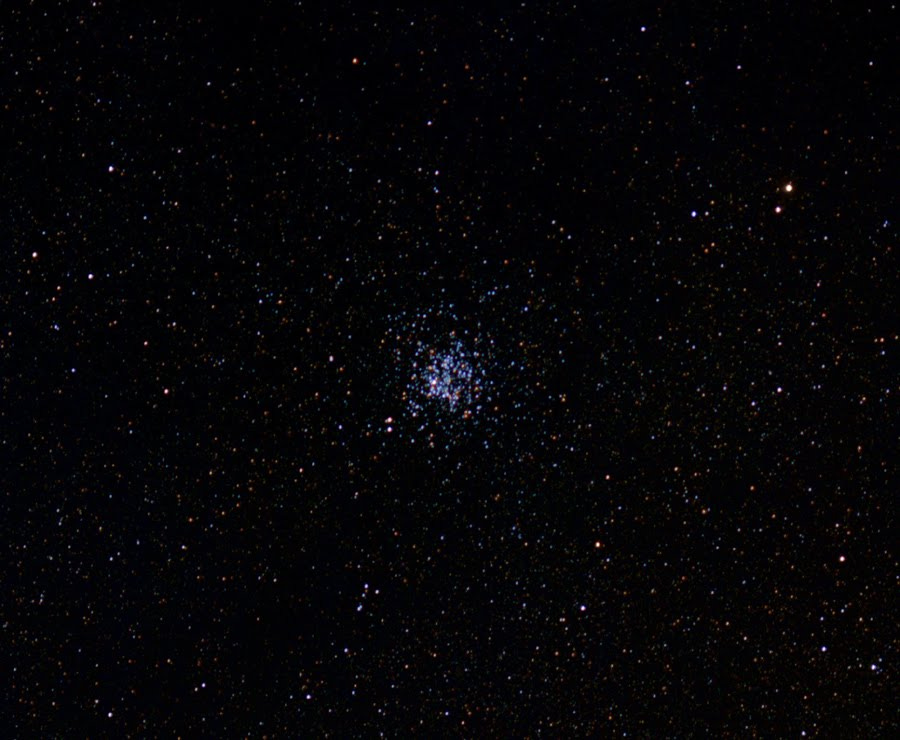
Being located in the heart of the Milky Way itself, Aquila is loaded with deep sky objects. Unfortunately, all of these require a large telescope and/or dark skies to see at all. One notable exception (though technically in Scutum) is M11, the Wild Duck Cluster, located just off the top of the eagle’s tail. Anyone who knows the night sky realizes that, when a Messier object has an actual name beyond its log number, it’s especially noteworthy for its beauty. The Wild Duck doesn’t disappoint. Very tight for an open cluster, the Wild Duck consists of splash of several dozen stars with a bluish tinge. Low to medium power is best here.
For double star fans, there are binaries aplenty, but many are so widely separated from their companions that their true natures will be hard to discern without knowing what one is looking at ahead of time. Altair itself is one such star: it has a +9.3 magnitude companion separated by 165 arc seconds from its +0.7 primary. There are, however, exceptions. Omicron Aquila is one such star. Easy to find thanks to its proximity to Altair, the +5 magnitude main is separated by 14 arc seconds from a +13 magnitude companion. Medium to large scopes are required here. A similar sight is 21 Aquila, located in the eagle’s body itself, though the separation just about doubles that of Omicron. Much more friendly to smaller scopes is 11 Aquila, a +5.2 main with a +9.5 companion 18 arc seconds distant. The real double jewel of the constellation is Pi Aquila, located just off the eagle’s beak. A +5.7 main with a +6.2 companion, these near twin white stars are split by just 1.4 arc seconds, making this star a great test for one’s optics as well as sky’s stability.
A Moment in Time
Distances across the stars are so vast that they’re measured in light years, which is the distance light travels in one year. For the record, light travels 186,000 miles per second. That’s enough to circle the Equator almost 7 ½ times in one second. So, when it is said that a given star is 10 light years distant, that means that the light we’re seeing from the star tonight is 10 years old and we’re actually seeing the star as it looked 10 years ago. When we look at the sky, we are looking back in time. For our moment in time tonight, we focus on Altair, alpha Aquila, which is located 16 light years away from us. When we look at Altair, we’re seeing as it appeared in 2010, a year in which amateur astronomy lost one of its greatest ambassadors.
It was on August 20, 2010, that ‘Stargazer’ Jack Horkheimer died following a lifelong lung illness. In a career showing that being in the right place at the right time is just as critical as being good at what you do, Jack Horkheimer went from writing programs at a newly-opened planetarium to hosting a local TV show in 1976 that would go national a decade later and then international a few years thereafter. The unique part about Horkheimer’s show: it wasn’t about astronomy the science, but astronomy the hobby, which requires only a pair of eyes. Horkheimer would star in his show right up until his death, with final episodes airing posthumously. With a total of 34 years on TV, millions of people came to know the enthusiastic Horkheimer who, at the end of every episode, always reminded people to “keep looking up!”
This is the Cliff’s Notes version. Click here if you want the full story of Jack Horkheimer!