
Ham in Space
Way Back Wednesday for Week of January 25-31

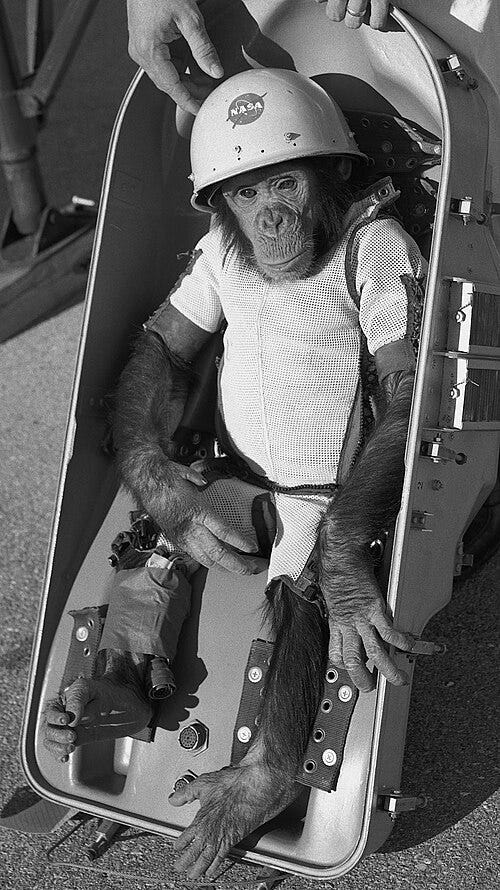
It’s a new Wednesday, which means for a new look back into the past, This week’s feature is an often-forgotten part of the Space Race. While the history books tout the names Sputnik, Gagarin, and Shepard often, there are other, forgotten parts to man’s early exploration of space. One of these moments took place this week in history when a chimpanzee named Ham became the first great ape to enter space on January 31, 1961.
The history of how the Soviet Union was first into space with Sputnik 1 in 1957 is known the world over even to people not familiar with history and space exploration. From then, it is widely assumed that the next major goal in the Space Race was to launch a human into space. While true, this simplistic telling of history leaves out many intermediate steps.
With orbit achieved by a machine, the next step was to see whether any living thing was capable of surviving in space. This task fell to a stray dog picked up from the streets of Moscow. Named Laika, “barker” in Russian, the dog was put through a series of hurried simulations of spaceflight on Earth before being launched into orbit on a one-way journey aboard Sputnik 2 on November 3, 1957. Only a month removed from the first satellite, long-term life support systems, let alone safe reentry ones, were non-considerations as many scientists doubted whether a trip to space was survivable at all. Laika proved that it was possible to survive in space, but wound up giving her life in the process after her capsule eventually overheated. Even without the cooling failure, Laika was doomed: Sputnik 2 was never destined to survive atmospheric reentry.
With life in space proven possible, returning to Earth became the next goal. Over the next few years, both the United States and Soviet Union launched various animals into space on ballistic, non-orbital, trajectories and brought them back alive. On August 19, 1960, the Soviets launched Sputnik 5 into orbit with a pair of canine passengers named Belka and Strelka. Both survived orbit and returned safely to Earth.
So far, the United States had been lagging behind the Soviets in the Space Race. The Soviets were first into space, first to launch an animal into space, and the first to launch and then successfully recover animals after an orbital spaceflight. Going into 1961, the United States was desperate for some kind of first-in-space distinction. This would come by way of a chimpanzee, later named Ham, the first great ape to enter space.
Ham was born in French Cameroon, brought to the United States, and sent to an exotic wildlife park in Florida. He was bought by the Air Force for $457 (just over $5,000 today) in July, 1959 and was among other chimpanzees that were being tested for spaceflight potential. The chimps were tested with their abilities to perform simple, timed tasks in reaction to light and sound stimulus. After months of testing, Ham, known then as #65, was selected to be the first great ape in space.
January 31, 1961 was launch day. Ham was fitted with numerous biometric sensors before being placed into his space capsule. Due to rocket malfunctions, Ham was subjected to extremely high g-forces upon
both launch and reentry. During his flight, Ham repeated the tasks he had learned in his training with responses only fractions of a second slower. The flight lasted just 16 minutes and 39 seconds, but it was enough to convince NASA that a human was not only capable of surviving in space, but of performing tasks as well.
Upon return to Earth, Ham, now officially named such, was found to have lost just over 5% of his weight due to dehydration but was in otherwise perfect health.
Following his historic flight, Ham continued with NASA until 1963, when he was allowed to retire from the space agency. Thereafter he was sent to the National Zoo in Washington D.C. He would spend 17 years there before being moved to the North Carolina Zoo in 1980. He would die there of natural causes in 1983, aged approximately 25.
Initial plans were to taxidermy Ham and display him at the Smithsonian. The Soviets had done the same with their space dogs, Belka and Strelka. After public outcry, Ham was instead buried, sans skeleton, at the International Space Hall of Fame. His skeleton is still held at the National Museum of Health and Medicine, albeit not on display. The capsule that carried him into space is on display at the California Science Center in Los Angeles.
The past is interesting and so is the present, which is why you should take a moment to check out my monthly guides to learn all about ‘what’s up’ in tonight’s sky.
The Monthly Sky
This Months’ Feature
Constellation of the Month
Fascinating! A good read - plus the title made me think of 'Pigs in Space' from the Muppets.