
Moon Meets Antares
Featured Sight for Week of July 19-25

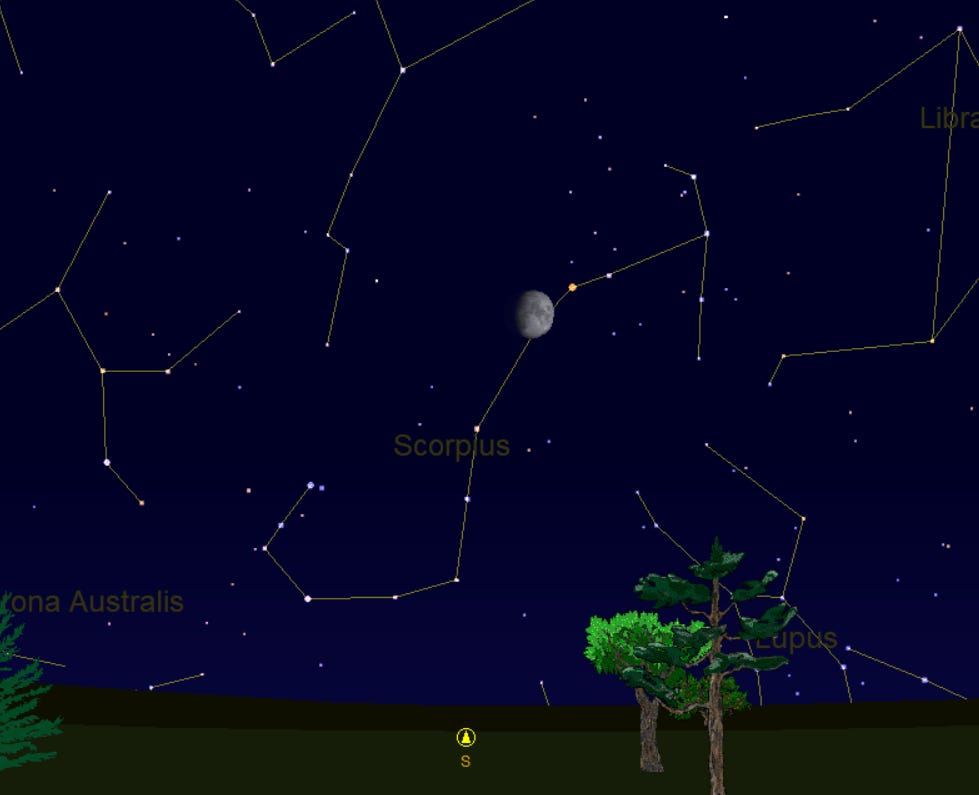
It’s a new week, which means a new feature in the night sky. This week’s focus may sound a little like a case of deja vu, which it is. Why? This week’s sight not to be missed is the Moon once again meeting Antares like it has done for several months leading up to the present. The big difference: this is now a twilight sight that allows for some extra fun!
Low in the South in the darkening sky, a bright, distinctly red star can be observed in the evening. This is Antares, alpha Scorpius, whose name means ‘rival of Mars’ in Greek thanks to the fact that its red color resembles that of the planet. On Friday evening, an added bonus will be in the picture as a waxing Gibbeous Moon will be just to the left of Antares low in the Southern sky.
To see the pairing, simply go out about 45 minutes to an hour after local sunset and look South. The Moon will be impossible to miss and just next to it will be Antares. The best part is that the pair will be about as high as they will get at the suggested time, albeit still very low. The good news is that Antares is still plenty bright enough to be visible in all but the most light polluted of settings.
Now for some extra fun!
If you have a pocket camera, there are two ways to catch the pairing.
If your camera has the capability to allow for manual focusing, utilize it to set the focus to infinity to ensure that the stars are points of light, not blobs. That done, set the self-timer (usually 10 seconds). If you have a tripod, use it or, if you don’t, set the camera on a solid surface and use other objects to aim it at the correct elevation. Camera aimed, hit the shutter button, wait out the timer, and see what appears in the LCD screen. Most pocket cameras have limited control over settings but should include an ISO setting. If the resulting picture doesn’t match what you see in the sky, raise/lower the ISO until you get the closest approximation.
If your camera doesn’t have manual focus, which is a good possibility, there’s a work-around here. Set the self timer first, focus on a far away light source, and press the shutter button. You’ll have (probably) 10 seconds to then get the camera aimed at Antares and the Moon before it snaps. As described above, adjust ISO until your picture best approximates the night sky.
If you own a camera capable of full manual control (as any interchangeable lens model will be), you’re in great shape and are free to play around with all the settings you desire in order to get an optimal exposure. My advice: open up the aperture and minimize the ISO to get a grain-free image.
A smartphone? Well, they’re pretty much full automatic in operation but have an uncanny ability to capture images in less than ideal lighting situations, so why not try it on the sky?
As the sky is still somewhat lit, this is a perfect opportunity to try and catch the pairing because the background brightness of the sky will do wonders in preventing an over-exposed Moon, which will make the Moon look like a bright blob and out shine Antares to the point that it may be impossible to capture the star cleanly.
Because Antares is so Southerly, the window to observe it is short. August will present yet another decent such opportunity to catch the pairing but Antares will be very low by the time the Moon makes its September visit.
Clear skies and good shooting!
Other Items of Note:
Tuesday marks First Quarter Moon
Come Wednesday, Saturn is now rising roughly 6 hours ahead of the Sun. With sunrise still quite early this time of year, this means that the Lord of the Rings is now easily observable in the skinny hours of the morning and can be viewed without having to stay up overly late.
On the other end of night, Venus is starting to sink in the Western sky just after sunset, setting roughly 2 hours after the Sun as of Thursday.
On Saturday, the Moon will be at apogee, a fancy word for saying that it is at its farthest from Earth in this trip around the Earth.
That’s it for the week, but there’s more for the month. Check out July’s Monthly Guides to plan some stargazing for the latter half of the month!


Given the difference in brightness between the Moon and the faint objects in the frame (M 4 and other globular clusters), I had thought of capturing the conjunction using a composite image. On one of these evenings, I wanted to photograph the field around Antares (with my camera and a 50 mm focal length, I can frame the entire “heart” of Scorpio and use long exposures because it tracks on its own without needing an equatorial mount) and then, on the evening of the conjunction, take a short exposure to avoid overexposing the Moon. Finally, I would composite the two images.
I’ve already realized how impossible this is, due to light pollution caused by the lights of the small town where I live. I live north of town, so the light diffused by the summer haze looks like swaths of light rising several degrees above the horizon. I’ve decided to write an article not so much about the conjunction but about light pollution...