
Planetary Conjunction Spawns the Black Death
Way Back Wednesday for the Week of March 15-21

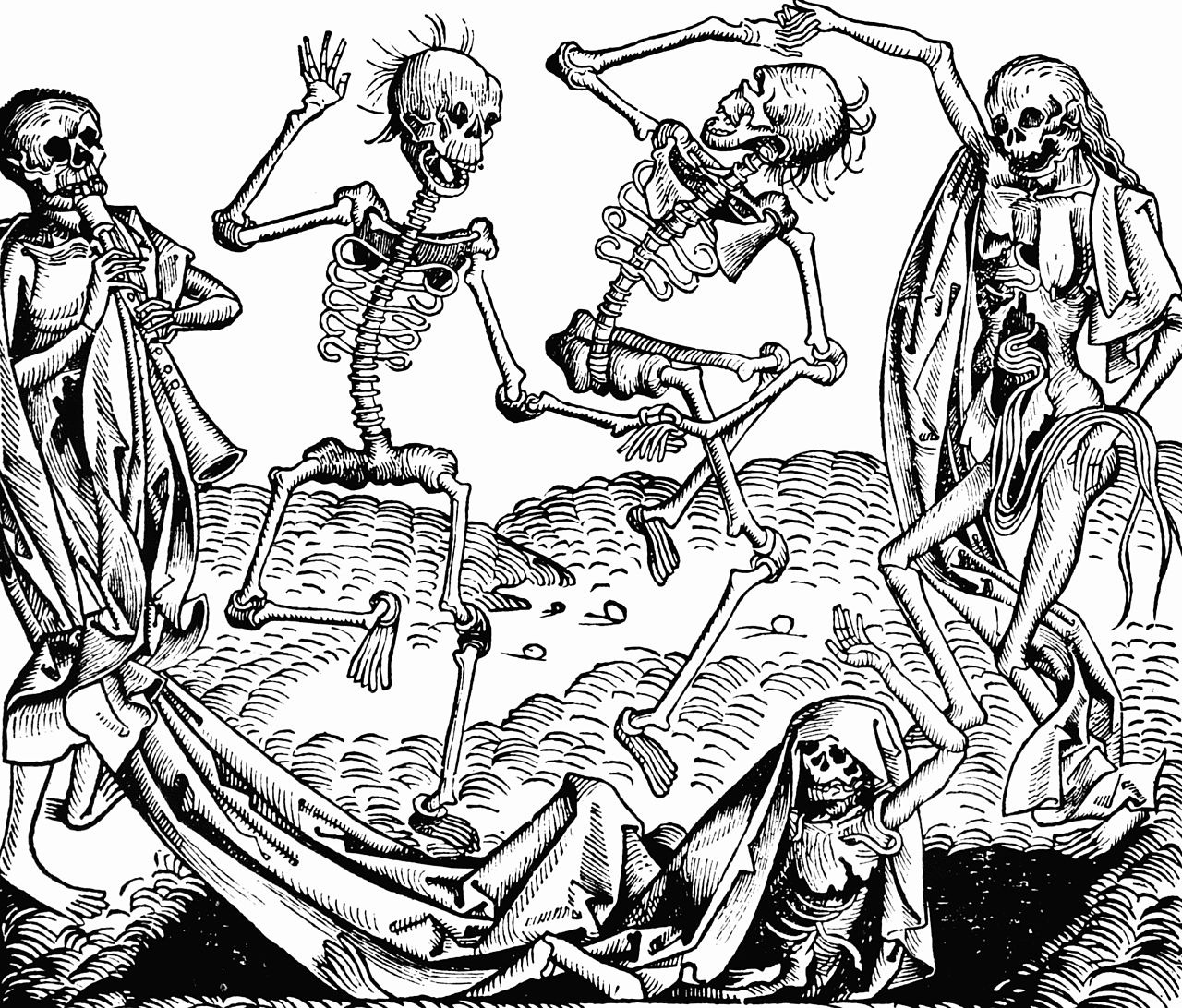
It’s a new week, which means for another trip back into history. Yes, that headline is not an early April Fool’s joke. This week’s drive through time takes us decidedly off the beaten path and examines the importance astrology held for our ancestors. It was during this week in history, specifically on March 20, 1345, that a planetary conjunction would come to be blamed for the Black Death.
In looking for things to write about for Way Back Wednesday, history.com’s This Day in History feature is one of my main go-to places to look for interesting historical events. If you’re an armchair historian like me and/or a history teacher and haven’t had a look at it, be sure to check it out! It came as a surprise when I saw on March 20 that there was an entry titled ‘Black Death is created, allegedly.’
I just had to click on the link.
The article stated that, at the time, it was believed that the Black Death was brought about by a close conjunction of Mars, Jupiter, and Saturn in the constellation of Aquarius on March 20, 1345. The rest of the article then detailed the Black Death and what we now know to be its true cause: the yersinia pestis bacteria.
But what of this whole astrology connection? I had to dig deeper.

Conjunctions of Jupiter and Saturn take place every 20 years. Even though astronomers of the time were using the incorrect geocentric model of the solar system, they were plenty smart enough to recognize past patterns and predict planetary motions. Even before it took place, astrologers were predicting special significance in regards to the Jupiter-Saturn conjunction of 1345. The addition of Mars nearby and a total lunar eclipse on March 18 also factored into the belief that the sky was forecasting something of monumental significance for Earth.
Siege warfare was common in the 14th century. From 1345-46, the city of Kaffa (now Feodosia) on the Crimean coast of the Black Sea was under the control of the Republic of Genoa in Italy. The Mongols wanted the strategic port city and lay siege to it in order to eject the Italian inhabitants. During the siege, the Mongol army was struck down by a mysterious, unusually deadly disease, the Plague. In order to both rid themselves of the putrid corpses while continuing to make war on their enemy, the Mongols catapulted the bodies of their dead over the city walls. Plague broke out in the city and the defenders fled in an effort to escape the disease. By this point, the Mongol threat was secondary.
In fleeing back to Italy, these survivors would unknowingly bring the disease-causing bacteria back to Europe with them when they finally made it back home in 1347. By the time the initial wave that became known as the Black Death finally burned itself out in 1353, anywhere between 30-60% of Europe had been wiped out by the Plague. The surviving records are far too sparse to affix any number with certainty.
Fast forwarding a few decades, astronomers/astrologers knew that there would be another spectacular conjunction, this time between Mars and Saturn, in 1373. By odd coincidence, there was another outbreak of Plague this year. It was only with the 1373 outbreak that astrologers looked into the past and noticed that the 1345 conjunction coincided with the first outbreak.
We now know that planetary conjunctions have absolutely no role in predicting events here on Earth except for people going out in large numbers to look skyward. Oh yes, the last similar conjunction of Jupiter and Saturn took place on December 21, 2020, which also happened to be the Winter Solstice for that year. While cloudy on the Solstice, I did manage to capture the planets the day before closest pass.


My photos in the above gallery represent 3 very practical perspectives. The first was taken with a 50mm lens on a full-frame dSLR and does a good job replicating the human field of vision. The second was shot with a 200mm telephoto lens, replicating the field of view offered by binoculars. The last was through a 600mm telescope, representing low telescopic power. The following day, the planets’ separation was approximately halved.
As history shows, sometimes truth is stranger than fiction.
The past is cool, but so is the present. Check out the Monthly Guides to see ‘what’s up’ tonight!


Makes you wonder what types of mythology we'd have if we were in a different solar system, had a different moon, or wound up someplace else in the galaxy...
Great post, thank you!
So interesting. Whether one believes it or not, I still find the way people have interpreted the skies in history to be fascinating, and shows that very human love for patterns and meaning.
Also noted is the coincidence of the most recent Jupiter Saturn conjunction happening during a pandemic (how could I forget! I even caught covid the following Christmas, though I know that was because someone in my family bubble caught it at work, not because two planets were getting cosy!)