
Pluto Discovered
Way Back Wednesday for February 15-21

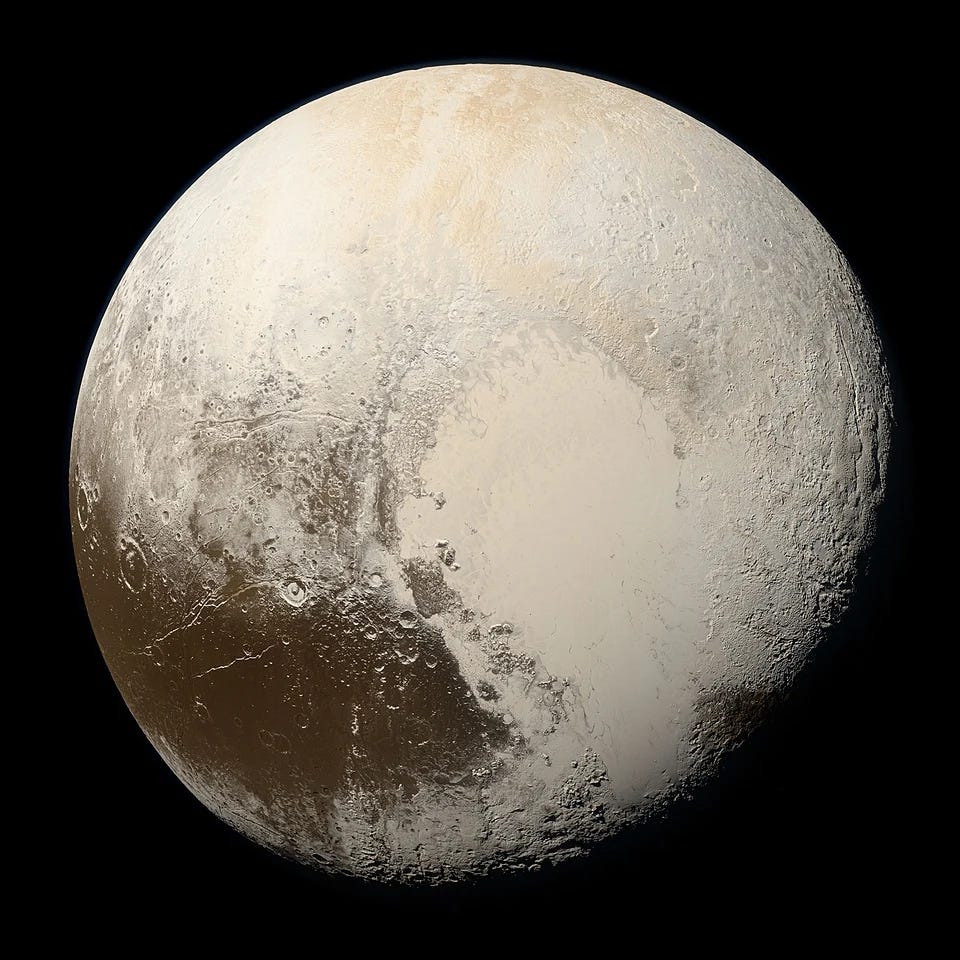
It’s a new week, which means that it’s time to take a new trip in the time machine to something way back in the history of our favorite hobby/science. This week’s feature revolves around a discovery that goes to show that science is not so much a collection of facts, but a continual process of self-correction. The item of focus: the discovery of our now former-planet Pluto, which took place on February 18, 1930.
To trace the history of Pluto, one must travel even farther back in time, to the 1780s.
In 1781, the solar system doubled in size literally overnight when William Herschel, professional musician and amateur astronomer, discovered a seventh planet from the Sun, the first planet discovered since antiquity, and the first planet discovered with a telescope. Its existence confirmed, the seventh planet, eventually to be named Uranus after much controversy, would become the target for many astronomers. However, with all the study, a problem emerged: Uranus did not orbit the Sun as Newtonian physics predicted it should, which implied a more distant, eighth planet tugging on Uranus and altering its orbital path.
Taking the observations and translating them to numbers, French mathematician Urbain LeVarrier made a bold prediction for where the hypothetical eighth planet would be found. In 1846, using LeVarrier’s math as a guide, German astronomer Johann Gallee discovered the eighth planet, Neptune, exactly where LeVarrier predicted where it would be located. The real kicker: it took Gallee less than an hour’s worth of searching. With his discovery, Gallee proved that mathematics could be used to find planets and thus began the true marriage of theoretical math and practical observation.
In the following decades, bad math and as-yet unknown phenomenon would take many astronomers on fools’ errands in the sky. With the discovery of General Relativity over 50 years in the future, the gravitational tug of another planet inside Mercury was the proposed solution for the perihelion advancement of Mercury’s orbit. In the intervening decades, many astronomers claimed to see a planet inside Mercury’s orbit transiting the face of the Sun. Unfortunately, no set pattern to the observations ever emerged and we now believe that what these astronomers were seeing were probably asteroids as we now know that no such planet exists. For the record, this hypothetical planet is known as Vulcan.
On the other end of the solar system, other scientists were claiming to find irregularities in Neptune’s orbit that suggested an even more distant 9th planet was causing the orbital perturbations. Result: the hunt was on for a planet beyond Neptune. Unfortunately, this was yet another cosmic runaround, this time by way of bad math.
Since the mathematical faults would not be discovered until decades later, the search for the 9th planet, commonly dubbed ‘Planet X,’ was a top goal for astronomers around the world. Percival Lowell, the man who founded Lowell Observatory for the purpose of proving life on Mars by way of cataloging its ‘canals,’ led the charge. Lowell and William H. Pickering worked together to suggest possible search areas for the hypothetical planet, but came up empty. After Lowell’s death in 1916, the search for Planet X would take a decade-long hiatus before resuming in the late 1920s with a 23-year old Clyde Tombaugh taking the reins of the project.
For a young amateur (yet to earn a college degree), the task was a daunting one but Tombaugh had a plan. As even a beginning astronomer knows, stars all stay in fixed positions relative to each other in the sky while planets move through the stellar background. In fact, the reasons that we call planets ‘planets’ at all is that the word means ‘wanderer’ in Greek. The idea was simple, yet effective. By taking pictures of the same area of sky several days apart and then comparing them for differences, Tombaugh would be able to spot anything moving against the fixed stellar background.
Finally, after nearly a year of taking long-exposure photos, inserting the plates into a blink comparator, and then probably straining his eyes tired to see if anything moved, Tombaugh found what he was looking for on February 18, 1930. When looking at two images taken nearly a week apart from the previous month, Tombaugh noticed a moving object. Further observations confirmed the existence of something moving around in the outer reaches of the solar system beyond the orbit of Neptune. Planet X was now Pluto, named for the Greek god of the underworld.
Now, here’s where the self-correcting nature of science comes to the fore.
Initially, astronomers had a very hard time determining the size of Pluto as it was so far away and the tools available at the time of discovery were primitive by today’s standards when it came to their planet-measuring capabilities. At discovery, Pluto was estimated to have a mass about that of Earth. Unfortunately for Pluto, as planet measuring capabilities improved, it only got smaller and smaller, eventually reaching the point where it was estimated to be smaller than many of the moons in the solar system, including our own. By 1978 and the discovery of its first known moon, Charon, Pluto was known to be only about 1/500th the mass of Earth. By virtue of its size alone, some scientists started to question whether Pluto deserved to be called a planet at all.
The next blow for Pluto came with the advent of digital imaging technology. For astronomers, digital CCD chips, which came into mass use in the 1990s, were far more sensitive than film and could reveal much greater details. With the advances in imaging technology, many objects at Pluto’s distance from the Sun were found. Now, with the fact known that Pluto was not unique at all, scientists were faced with a dilemma: start adding more planets to the solar system (and thus overwhelm the minds of schoolchildren the world over) or reconsider the definition of a planet.
The final blow to Pluto’s status as a planet came on July 29, 2005, when the existence of Eris, a body 3 times more distant but nearly 30% more massive than Pluto, was confirmed. Eris was discovered by astronomer Mike Brown, who, in a TV interview, recalled calling his wife immediately after the discovery to announce that he had discovered the 10th planet. Unfortunately for Brown, he would not enter the Pantheon of astronomers occupied by the other planet finders: Tombaugh, Gallee, and Herschel. Instead, Brown’s ‘planet’ was considered merely the largest in a series of Trans-Neptunian objects discovered since the advent of digital imaging. As a result, despite being larger than Pluto, Eris would never gain planetary status while Pluto would retain its status as the 9th planet.
It was because of this problem, how could the larger of two distant bodies be considered not a planet while the smaller one was a planet, that the scientific community began to reassess the definition of the word ‘planet.’
Result: on August 24, 2006, the International Astronomical Anion (IAU) came up with the following definition of the word ‘planet,’ which reads: “a body that circles the Sun without being some other object’s satellite, is large enough to be rounded by its own gravity (but not so big that it begins to undergo nuclear fusion, like a star) and has cleared its neighborhood of other orbiting bodies.” Obviously, Pluto met the first 2 conditions (it orbits the Sun and nothing else, it is round), but not the third, as it has failed to clear its neighborhood thanks to the fact that its largest moon, Charon, is not a true moon in that Charon does not orbit Pluto, but both bodies orbit a point in space between them where their gravitational fields meet, making for more of a double planet system than a planet-moon one.
For many people, both scientists and especially members of the public, the demotion of Pluto was a tough pill to swallow as most everyone alive (save the people 77+ years of age at the time) grew up on the notion of 9, not 8, planets. In fact, there was even a massive ‘save Pluto’ petition being circulated online, but to no avail as the IAU refused to budge on this question of what defines a planet.
So, whatever you wish to call it, it was during this week in history that Pluto became known to the world.
That’s it for the week, but there’s a lot more for the remainder of the month!


