
The Red Planet Returns
Featured Sight for Week of June 28-July 4

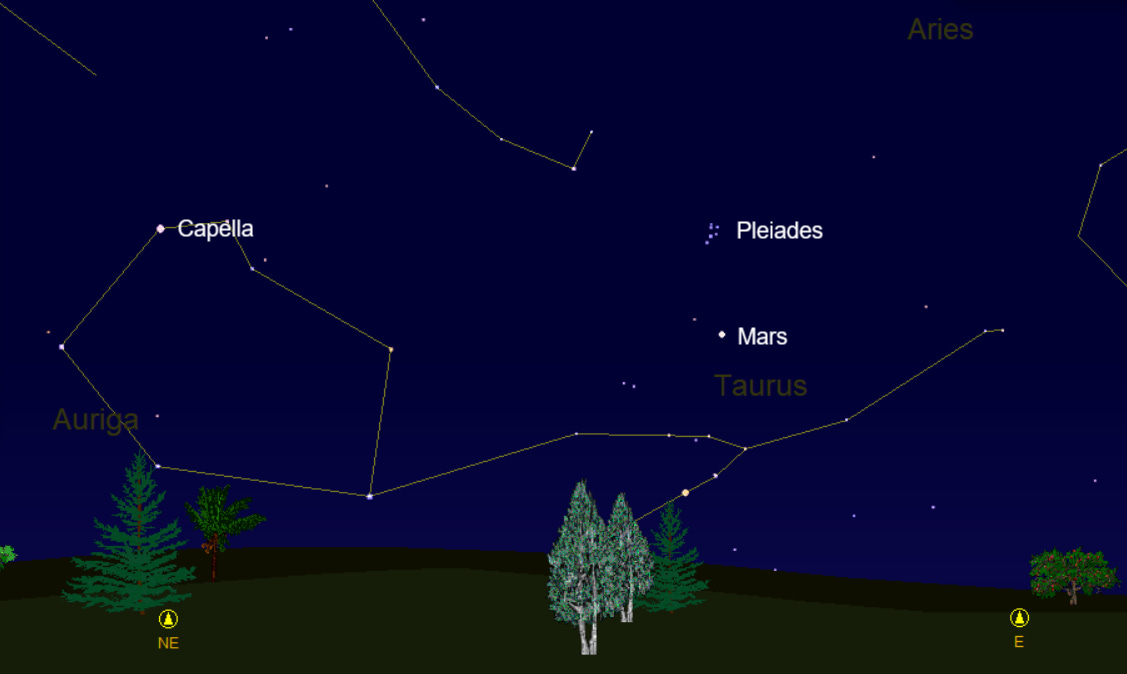
It’s a new week, which means that it’s time to spotlight something especially noteworthy in the sky yet again. This week’s feature is all about a planet that, if you’ve been following me awhile, have yet to see mentioned: Mars. Yes, after months of invisibility, the Red Planet is once again returning to our skies.
So, how to see it.
To see Mars right now may involve rearranging one’s schedule a bit. This week, Mars rises approximately 2 hours ahead of the Sun, which means that there is a realistic possibility of catching the long-MIA planet about an hour before sunrise by looking low in the East. How low does one need to look? You’ll need a clearance of about 10 degrees from the horizon. Use your handy hand to determine if your observing spot is a good one. If it is, great. If not, start scouting out another location. The good news is that Mars is only going to be getting better in the coming days, weeks, and months.
Once you have an observing location picked, arrive at your spot about an hour before your local sunrise time. As the sky will be starting to brighten noticeably by now, you may want to bring the binoculars if you have them as, though not hard to see from a dark site, lights near the horizon can play havoc with spotting the planet in a built-up area.
To aid in finding Mars, look for bright, white Capella in the Northeast. Shining at magnitude +0.2, Capella is about 2 ½ times brighter than Mars (+1.3 now) but sits at roughly the same elevation. Capella found, shift your attention to about 30 degrees right and start looking. So long as nothing near the horizon is blocking the view, the Red Planet should pop into view rather quickly.
The good news: Mars is only going to get brighter and easier to see at a more reasonable hour, eventually coming to opposition on February 19, 2027.
Other Items of Note:
Tonight, the Moon is at a spot in its orbit called apogee, which is just a fancy way of saying that the Moon will be as far away from Earth as it can get today.
The Summer Solstice was a week ago but, as nonsensical as it seems, the latest sunsets of the year are taking place this week. Why? The Earth’s orbit is not a circle and the Sun is not at the center. For the in-depth explanation, go here and read all about it!
Summer is here and the signs are written in the stars. Come midnight, which is not too long after the arrival of true night for most of us, Scorpius is just about due South and in prime position for viewing. Due to its Southerly location, hurry to view it and its telescopic treasures as it won’t be sticking around for long. On the opposite side of the sky, the Big Dipper is now bowl-down in the North.
Returning to Mars, if you have a telescope or, at the very least binoculars, it will be at its closest to Uranus on Saturday. Go here for a detailed finder chart to help guide you on your search for the former Planet George! The best news: the pair is just about directly below the Pleiades, which makes them easy too find.
That’s it for the week. However, there’s a much bigger picture going on in the sky right now. Check out the Monthly Guides to stay current on ‘what’s up’ in a sky above you!


