
The Space Shuttle Program Announced
Way Back Wednesday for Week of January 4-10

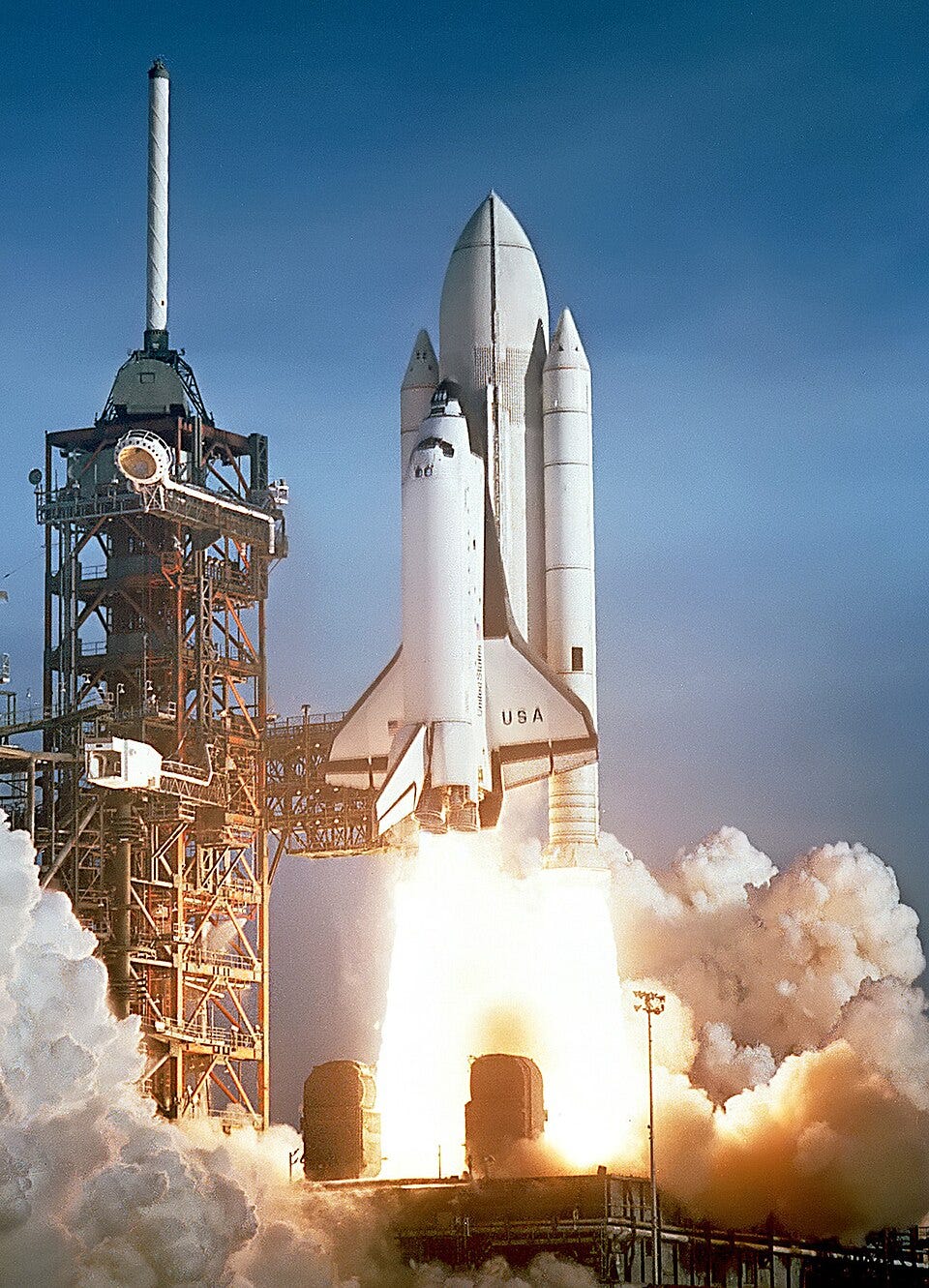
It’s a new week, which means a new trip back in time. For this week’s highlight, we examine a NASA program that spanned an entire generation, the Space Shuttle, which was announced to the public on January 5, 1972.
Even before Apollo 11 touched down on the Moon, NASA was eyeing the future. For all of their technical achievements, there was one glaring flaw with the rocket technology of the time: no single component was reusable. With the race to the Moon nearing its conclusion, NASA top brass realized that public support for such huge financial investments in the space agency would fade once the Space Race was won. To that end, NASA looked toward economizing when planning for its future.
As early as October, 1968, NASA started seriously contemplating the feasibility of a reusable space vehicle. In June, 1970, NASA came up with far more detailed plans for such a spacecraft. As different NASA teams worked on developing the agency’s post-Apollo plans, the Shuttle became the front runner due in large part to intense lobbying by its proponents.
As the shuttle program looked more and more likely to be NASA’s future, its developers were in a three-way balancing act between different factors: development cost, operational cost, and vehicle capabilities. The vehicle capabilities part became especially important once it was announced that the Saturn V would no longer be produced. NASA’s Moon rocket was capable of lifting over 300,000 pounds into orbit. The initial Shuttle design’s capacity? A mere 20,000 pounds. Clearly, the Shuttle’s payload capacity would have to grow while costs would have to be kept down.
The original concept called for a pair of craft that were both completely reusable. The larger of these would be a booster, on the back of which would ride the smaller orbiter. In this concept, the booster would take the orbiter to a predetermined altitude before the craft separated. The booster would then land while the smaller orbiter would power up and continue on its trip into low Earth orbit under its own power before landing upon completion of its mission. In the end, this plan was scrapped because it was deemed too costly to develop and the orbiter would not be big enough to carry the desired payloads into orbit. In a way, the concept survived in that it became common to transport the shuttles long distances while piggybacked on a much larger jet.
In order to economize, NASA changed its requirement to a craft that was partially reusable. The Space Shuttle would consist of three main parts: two rocket boosters, an external fuel tank, and the orbiter. Of the three, only the external tank was one-and-done as the rocket boosters were designed to be refurbished and reused. While it was only able to be used once, the external fuel tank solved a major problem for NASA: payload capacity. Without its own internal fuel supply, more space could be devoted to a cargo bay that would allow the orbiter to carry up to 65,000 pounds.
So confident in the design that was being developed, President Nixon announced the Space Shuttle to the public on January 5, 1972, which was before the contract to build the craft had even been awarded. Lockheed Aircraft, Grumman, McDonnell Douglas, and North American Rockwell all submitted proposals of their own designs based on NASA’s requirements of a partially reusable craft. It was the North American Rockwell proposal that NASA accepted. The company was awarded the contract to build the Shuttle on July 26, 1972.
Unfortunately, the whole hope of a simpler, cheaper way into space would not become reality. Technical issues brought about cost overruns that turned into project delays. The first Space Shuttle launch would not take place until 1981.
Upon retirement of the Shuttle fleet in 2011, there has been much said about the program when looking back in retrospect. There is no doubt in that the Shuttle accomplished what it was designed to do: serve as a mostly reusable craft capable of launching large payloads into orbit. Unfortunately, there is also no doubt about the fact that the Shuttle fell far short of the initial expectations, namely the bi-weekly flight schedule and all the profits it would bring for NASA by way of placing commercial satellites into orbit. Even Michael D. Griffin, NASA Administrator from 2005 to 2009, argued in a 2007 article that NASA over promised and under delivered with the Shuttle, saying that space exploration would be in a far more advanced state if NASA had simply stayed with the known quality that was the Saturn V.
Still, no matter how you view the Shuttle’s legacy, it is a cultural icon for all who were old enough to appreciate manned spaceflight during the 30 years it was flying.
For More Info:
Space Shuttle Announcement
The past is interesting, and so is the present. So why not check out January’s monthly guides and get caught up with all the goings-on in the night sky?
The Monthly Sky
Visual Observing Calendar
This Months’ Feature
Constellation of the Month